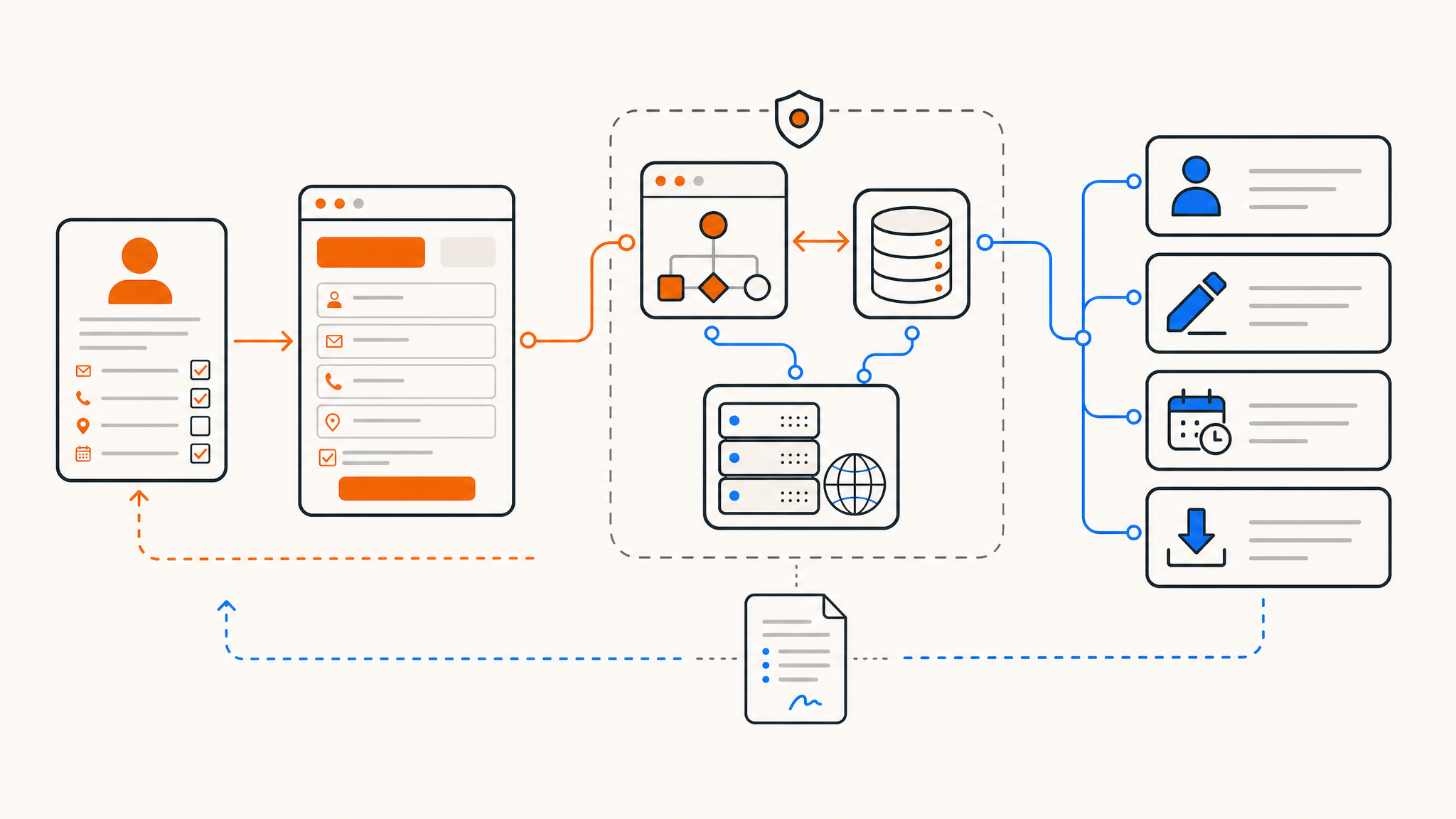
If you run a website, app, or any kind of online service that touches European users, you've almost certainly run into GDPR at some point, whether it was a compliance checklist, a cookie banner, or a legal notice from a lawyer. But what does GDPR actually require, and why does the physical location of your server play a bigger role than you'd expect?
This article breaks down what GDPR is, what it means for your data and your users, and how hosting location factors into the equation.
What GDPR is
The General Data Protection Regulation (GDPR) is a European Union regulation that took effect in May 2018. It governs how organizations collect, process, store, and transfer personal data belonging to people in the EU and EEA (European Economic Area).
"Personal data" under GDPR is broadly defined — it includes names, email addresses, IP addresses, location data, cookies, and anything else that can identify a specific person, directly or indirectly.
GDPR applies to any organization that handles EU residents' data, regardless of where that organization is based. A company in the United States or Singapore that collects email addresses from European visitors is subject to GDPR just the same as a company in Germany.
Core principles you need to know
GDPR is built around a set of data processing principles. In plain terms, they require that:
- You have a lawful basis for collecting data (consent, contract, legitimate interest, etc.)
- You collect only what you need — no hoarding data "just in case"
- Data is accurate and kept up to date
- Data is deleted or anonymized once it's no longer needed
- Data is protected with appropriate security measures
- You can demonstrate compliance — the burden of proof is on you
Beyond these principles, GDPR grants individuals a set of rights: the right to access their data, correct it, delete it (the "right to be forgotten"), restrict its use, and in some cases, move it to another provider.
How GDPR applies to your users' data
If you run a contact form, email newsletter, analytics tool, or user account system, you're processing personal data. That means you need to:
Have a privacy policy that explains what data you collect, why, how long you keep it, and who you share it with.
Get valid consent where required — pre-ticked boxes don't count, and bundled consent (agreeing to terms plus marketing in one click) isn't valid either.
Use data processors that are also GDPR-compliant. This includes your hosting provider, your email platform, your analytics tool, and any third-party service that touches user data. If they're not compliant, that's your problem too.
Report breaches to the relevant data protection authority within 72 hours if there's a risk to individuals.
Why hosting location matters
This is where things get genuinely technical — and often overlooked.
GDPR restricts where personal data can be transferred. Moving data outside the EU/EEA to a country that doesn't provide an "adequate" level of data protection requires additional legal safeguards, like Standard Contractual Clauses (SCCs) or binding corporate rules.
The United States, for example, is not on the EU's adequacy list as of this writing, which is why the legal validity of US-based data transfers has been the subject of repeated court challenges (Safe Harbor, Privacy Shield — both invalidated). The EU-US Data Privacy Framework adopted in 2023 is the current mechanism, but it remains subject to legal scrutiny.
Hosting your data in the EU sidesteps a lot of this complexity. If your servers are physically located within the EU and operated by a company subject to EU jurisdiction, you're not triggering cross-border transfer rules at all. The data stays where GDPR governs it.
What "GDPR-compliant hosting" actually means
There's no official certification for "GDPR-compliant hosting" — any provider can claim it. What you're actually looking for is:
EU-based infrastructure. Servers located physically within the EU, not just a European office with data routed through US datacenters.
Data processing agreements (DPAs). GDPR requires a written agreement between you (the data controller) and any service provider that processes data on your behalf (a data processor). Reputable hosting providers offer these.
Minimal data collection by the provider. The hosting provider itself shouldn't be collecting and sharing your users' data for its own purposes.
Transparency about subprocessors. If your hosting provider uses third-party services that handle data (CDN, backup storage, etc.), those should be disclosed.
Physical and network security. Tier III or Tier IV datacenters, encrypted storage, and defined access controls all factor into your overall GDPR posture.
Netherlands hosting and GDPR
The Netherlands is a particularly strong choice for EU-compliant hosting for a few reasons. It's fully subject to GDPR like all EU member states. The Dutch Data Protection Authority (Autoriteit Persoonsgegevens) is an established regulator with clear guidance. And practically speaking, the Netherlands — particularly Amsterdam — sits at the center of European internet infrastructure, with major internet exchanges like AMS-IX providing low-latency connectivity across Europe.
Hosting in the Netherlands means your data is unambiguously within EU jurisdiction, without the need for transfer mechanisms or supplementary legal frameworks.
What you're still responsible for
Even with EU hosting, GDPR compliance isn't automatic. The hosting provider handles infrastructure security and data processing agreements; everything else is still on you.
That includes your application's security, how you handle user consent and cookie banners, your privacy policy, how long you retain user records, and what third-party scripts you load (Google Analytics, Facebook Pixel, etc. all have their own compliance implications).
Hosting in the EU is a necessary condition for a clean GDPR posture — it's not a sufficient one on its own.
Thanks for reading!
If you need hosting that keeps your data within EU jurisdiction, QDE offers high-performance VPS in the Netherlands, hosted in a Tier III Amsterdam datacenter with direct AMS-IX peering, NVMe storage, and 10 Gbps uplinks. We collect minimal data, offer data processing agreements, and don't share your data with third parties.
Ready to get set up or have questions about our infrastructure? Contact our team to find the right plan for your project.
Frequently asked questions about GDPR and hosting
Does GDPR apply to me if I'm not based in the EU?
Yes, if you collect or process personal data from EU or EEA residents — regardless of where your business is located — GDPR applies to you. This includes website visitors, email subscribers, and customers.
Does hosting in the EU make me GDPR-compliant?
Not automatically. EU hosting removes cross-border data transfer complications, but you're still responsible for your privacy policy, consent mechanisms, data retention practices, and the compliance of third-party tools you use.
What's a data processing agreement (DPA) and do I need one?
A DPA is a contract between you (as data controller) and any third party that processes personal data on your behalf (a data processor, like a hosting provider). GDPR requires these agreements to be in place. Reputable hosting providers offer them as a standard part of their service.
What happens if I don't comply with GDPR?
Fines can reach up to €20 million or 4% of global annual turnover, whichever is higher — for serious violations. Lesser violations carry fines up to €10 million or 2% of turnover. Beyond fines, regulators can issue orders to stop processing data, which can be operationally disruptive.
Is the Netherlands a good choice for GDPR-compliant hosting?
Yes. The Netherlands is fully subject to GDPR, has a well-established data protection authority, and Amsterdam's network infrastructure (including AMS-IX) provides excellent connectivity across Europe with no data sovereignty complications.
Does QDE offer data processing agreements?
Yes. QDE is operated by Hizakura B.V., a Netherlands-based company, and offers data processing agreements to customers who require them for GDPR compliance purposes. Contact us for details.