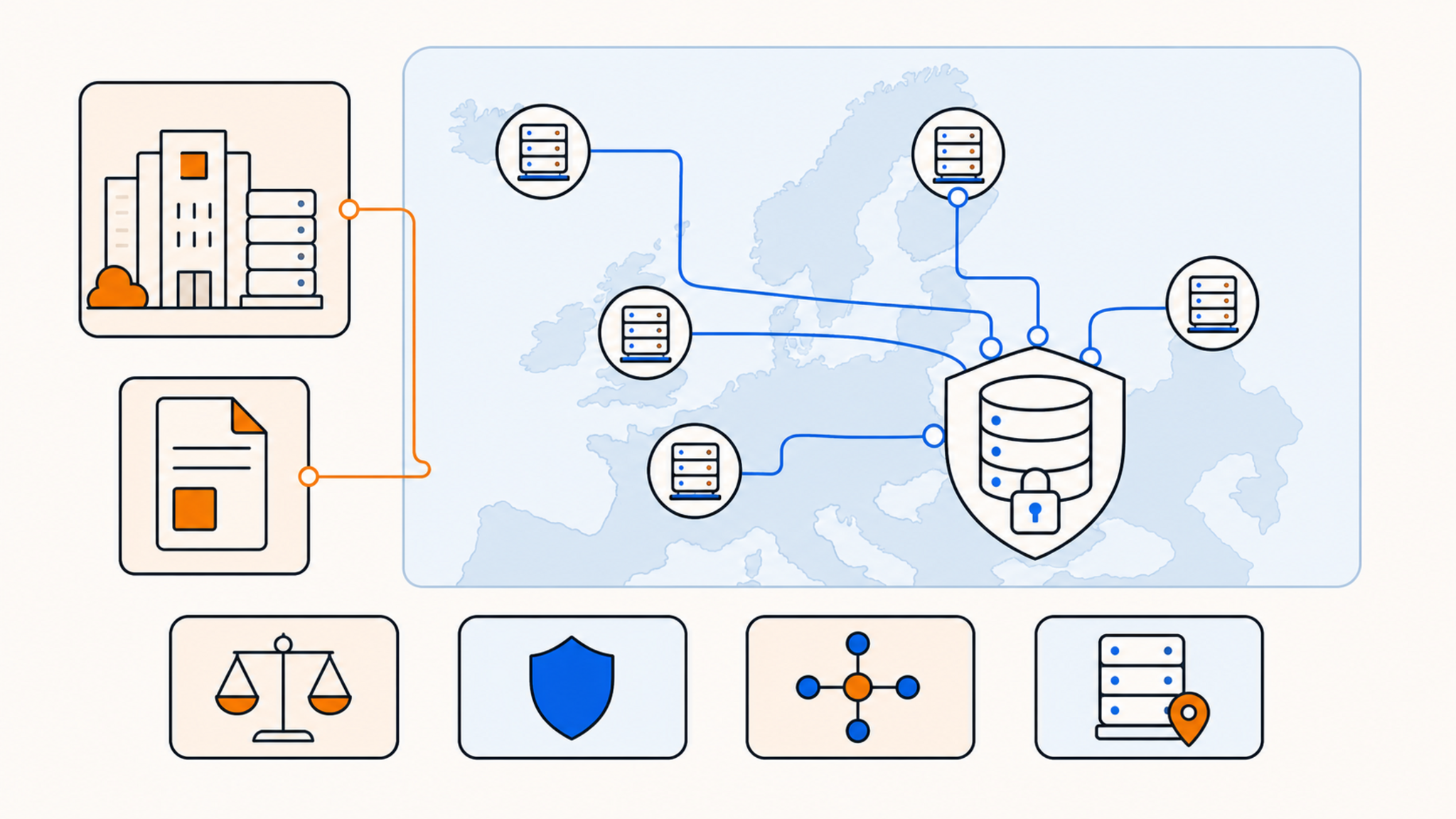
Data sovereignty gets treated as a checkbox more often than it should. In reality, the country your server physically sits in determines which laws actually govern access to your data, who can legally compel disclosure, and what protections your customers can rely on if something goes wrong.
GDPR sets a baseline across the EU, but individual countries layer additional rules, court precedents, and enforcement cultures on top of it. Here's a look at five that stand out for privacy-conscious hosting, and what actually separates them from each other.
Quick comparison
| Country | EU/EEA status | Governing framework | Notable for |
|---|---|---|---|
| Netherlands | EU member | GDPR via the UAVG | AMS-IX infrastructure, many established brands operating for a long time in the Netherlands without issue that couldn't in other European countries |
| Switzerland | Non-EU, non-EEA | FADP (GDPR-aligned) | Independence from EU data-sharing frameworks |
| Iceland | EEA (non-EU) | GDPR via the EEA | Longstanding info-freedom and press-freedom legislation |
| Finland | EU member | GDPR | Heavy investment in cybersecurity infrastructure |
| Estonia | EU member | GDPR | Digital-first governance, e-Residency program |
Why the specific country matters, not just "the EU"
GDPR applies across all EU member states, so in theory, data hosted anywhere in the bloc gets the same baseline protection. In practice, national implementation laws, local court interpretations, and how aggressively each country's data protection authority enforces the rules can differ meaningfully.
A server in one EU country isn't automatically equivalent to a server in another once you look past the headline regulation. The difference shows up specifically in enforcement track record, how national security and law enforcement access requests are handled, and how mature the local data protection authority's investigative process actually is.
1. The Netherlands
The Netherlands has built a reputation as one of Europe's strongest hosting hubs, partly infrastructure (Amsterdam's AMS-IX is one of the world's largest internet exchanges) and partly regulatory.
Dutch data protection law implements GDPR through the UAVG (Uitvoeringswet Algemene Verordening Gegevensbescherming), the national implementing legislation that fills in the details GDPR leaves to individual member states. The country's data protection authority (Autoriteit Persoonsgegevens) has a track record of active enforcement, which tends to correlate with providers taking compliance seriously by default rather than treating it as an afterthought.
2. Switzerland
Switzerland isn't an EU member, so it operates under its own law, the Federal Act on Data Protection (FADP, revised and brought into force in recent years to align more closely with GDPR), rather than GDPR directly. The two frameworks are broadly similar in spirit, but Switzerland's stronger banking-privacy tradition and independence from EU-level data-sharing agreements and law enforcement cooperation frameworks make it an appealing option for businesses specifically trying to minimize exposure to non-European legal requests, including requests originating outside Europe entirely.
3. Iceland
Iceland sits outside the EU but inside the European Economic Area, meaning it applies GDPR while also benefiting from a legal and political environment historically friendly to data privacy and press freedom, partly stemming from earlier legislative efforts specifically aimed at making Iceland a haven for information freedom and source protection.
It's a smaller hosting market than the Netherlands, with a correspondingly smaller pool of providers to choose from, but it's worth knowing about for projects specifically prioritizing legal distance from larger jurisdictions.
4. Finland
Finland combines GDPR compliance with a strong national reputation for data protection and cybersecurity infrastructure, backed by significant government investment in digital infrastructure security over the past decade. It's less commonly discussed than the Netherlands in hosting circles, but it's a reasonable option for businesses wanting Nordic-region infrastructure with solid regulatory backing and a stable, well-governed legal environment.
5. Estonia
Estonia has built its entire digital government infrastructure around strong data protection principles, most visibly through its e-Residency and digital ID programs, and that culture extends into its hosting and tech sector more broadly. It's a smaller market, but its digital-first governance model, clear regulatory environment, and status as an EU member with a comparatively young, tech-forward legal framework make it worth considering, particularly for businesses already operating in the Baltic or Nordic region.
What "data sovereignty" actually protects you from
Choosing a privacy-conscious country isn't just about avoiding vague risk. It has concrete implications: which government agencies can legally compel a hosting provider to hand over customer data, whether cross-border data transfer restrictions apply if you also use US-based services (a question that became significantly more complicated after the Schrems II ruling invalidated the previous EU-US Privacy Shield framework), and how quickly and thoroughly a data protection authority actually investigates complaints.
None of this shows up on a hosting provider's pricing page, but it's exactly what data sovereignty is meant to address, and it's worth understanding before assuming that "hosted in the EU" is a sufficient answer on its own.
Questions to ask before choosing
- Is the provider's legal entity actually incorporated in the country where the servers are located, or just the data center?
- Does the provider publish a clear data processing agreement (DPA) that names the exact jurisdiction?
- How has the country's data protection authority handled recent enforcement cases, and are those decisions publicly available?
- Does the provider avoid unnecessary data sharing with third parties outside the jurisdiction?
- If the provider (or its parent company) has ties to a non-European country, does that create any secondary legal exposure, similar to the concerns that originally drove the CLOUD Act debate around US-headquartered cloud providers?
How this interacts with your own compliance obligations
Choosing a privacy-friendly country for your hosting doesn't automatically make your own business GDPR-compliant. It addresses one piece, where the data physically lives and which government's laws apply to compelled disclosure, but you're still responsible for lawful data collection, honoring data subject access requests, maintaining appropriate security measures, and documenting your own processing activities. Server jurisdiction is a foundation to build compliance on top of, not a substitute for it.
Wrapping up
There's no single "most private" country in Europe, since the right choice depends on what you're trying to protect against and which legal traditions you trust most. What matters is treating server location as a real compliance decision rather than an afterthought, since it directly shapes which laws and authorities actually govern your data, and verifying a provider's specific claims rather than assuming EU-based hosting is a uniform guarantee.
Thanks for reading! QDE is based in the Netherlands and operates its infrastructure from a Tier III data center in Amsterdam, with minimal data collection and no third-party data sharing under GDPR. If you're exploring privacy-focused hosting, QDE provides high-performance, unmanaged VPS hosting backed by NVMe storage and 10 Gbps uplinks.
Frequently asked questions about data sovereignty and EU hosting
Does GDPR apply the same way in every EU country?
The baseline rules apply everywhere, but national implementation laws, enforcement culture, and how aggressively local data protection authorities pursue complaints can vary meaningfully between countries.
Is Switzerland a good choice even though it's not in the EU?
Yes, for many businesses. Switzerland's Federal Act on Data Protection (FADP) closely mirrors GDPR while adding its own strong privacy tradition and independence from EU-level data-sharing frameworks.
Why does the Netherlands come up so often in hosting discussions?
It combines strong data protection enforcement under the UAVG with excellent physical network infrastructure, particularly Amsterdam's AMS-IX internet exchange, making it attractive on both legal and technical grounds.
Does choosing a privacy-focused country cost more?
Not inherently. Pricing depends more on the specific provider and hardware than on the country itself, though some jurisdictions have a smaller pool of providers to choose from, which can slightly limit price competition.
What should I check to confirm where my data actually lives?
Ask your provider directly which country the physical servers are located in and look for a clear data processing agreement (DPA) that names that jurisdiction explicitly, rather than assuming based on the provider's marketing or company address.
Does hosting in a privacy-friendly EU country make my business automatically GDPR-compliant?
No. It addresses where your data lives and which government's disclosure laws apply, but you're still responsible for your own lawful data collection practices, security measures, and handling of data subject requests.
What is Schrems II, and why does it come up in these discussions?
Schrems II is a 2020 Court of Justice of the European Union ruling that invalidated the previous EU-US Privacy Shield framework for transatlantic data transfers, adding legal uncertainty for businesses combining EU-hosted data with US-based service providers, and reinforcing why some businesses prefer keeping the entire data path within Europe.