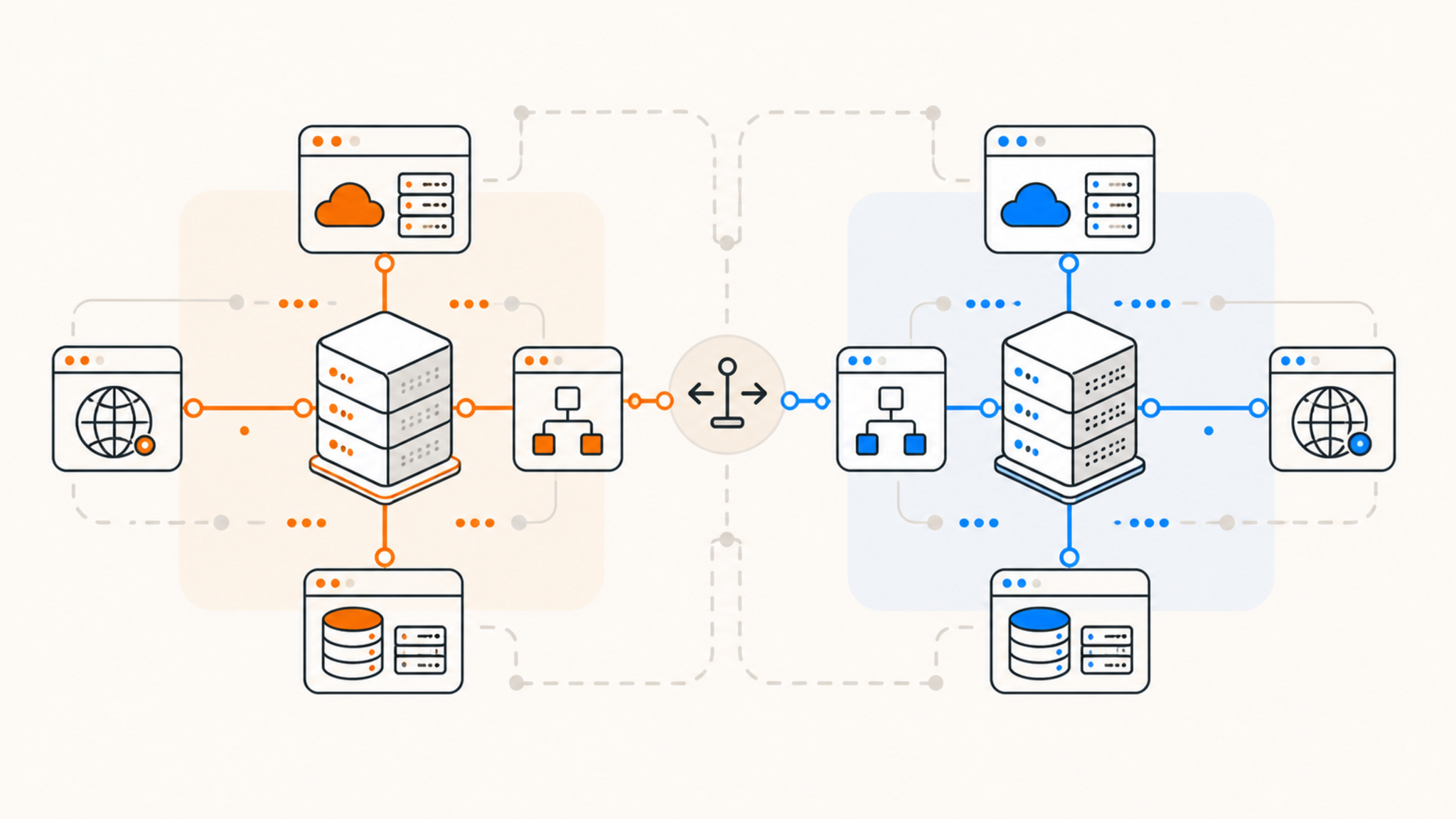
If you've spent any time reading about European hosting, you've probably seen AMS-IX and DE-CIX mentioned as a mark of quality, usually in a single line like "peers directly at AMS-IX" without much explanation of what that actually means. Both are internet exchange points, and both consistently rank among the largest in the world by traffic.
Understanding what they do helps explain why the phrase "direct peering" matters more than it sounds like it should, and why two servers with identical specs can perform very differently depending on the network behind them.
What is an internet exchange point?
An internet exchange point (IXP) is a physical facility where multiple networks, internet service providers, hosting companies, content delivery networks, and others, connect their equipment to exchange traffic directly with each other. Without an IXP, traffic between two networks might have to travel through several other networks (called transit providers) to get from one to the other, adding hops, latency, and cost along the way.
By connecting directly at a shared exchange, networks can send traffic to each other in a single hop instead of routing through a chain of intermediaries. This is called peering, and it's one of the main reasons "distance" on the internet is measured in network hops and milliseconds rather than kilometers.
A server in Amsterdam and a server in Frankfurt might be roughly the same physical distance from a given visitor. But if one network peers efficiently at a major exchange and the other routes through three additional transit providers to reach the same destination, the difference in latency can be significant.
How peering actually works, mechanically
When two networks agree to peer at an exchange, they connect their own routers to the exchange's shared switching fabric and establish a BGP (Border Gateway Protocol) session between each other. From that point on, traffic destined for the other network's IP ranges takes the direct path across the exchange instead of going out to a transit provider and back.
Peering agreements come in two general flavors: settlement-free peering, where neither side pays the other because both benefit roughly equally from the direct connection, and paid peering, where one network pays for the arrangement because the traffic exchange is heavily one-sided. Most peering at major exchanges like AMS-IX and DE-CIX is settlement-free between similarly sized networks.
What is DE-CIX?
DE-CIX is an internet exchange headquartered in Frankfurt, Germany. Frankfurt is DE-CIX's flagship location and, taken on its own, is generally considered the largest single internet exchange in the world by peak throughput, having set a Frankfurt-specific record of roughly 19.6 Tbps in July 2026, with more than 1,000 networks reachable across over 30 data centers in the city.
Frankfurt itself is a major European internet hub, partly because of its central geographic location within Europe and partly because DE-CIX has attracted such a dense concentration of networks that connecting there has become self-reinforcing: more networks show up because other networks are already there, which is sometimes called a network effect in exchange economics.
DE-CIX has also expanded well beyond its original Frankfurt location, operating more than 60 Internet and Cloud Exchanges in other cities globally, including several outside Europe entirely. It's worth knowing that DE-CIX's biggest headline traffic figures, its global network set an all-time peak of roughly 29.5 Tbps in July 2026, are combined totals across that entire international footprint, not the Frankfurt exchange in isolation.
What is AMS-IX?
AMS-IX is the internet exchange based in Amsterdam, and it's one of DE-CIX's closest rivals in scale, consistently among the top exchanges worldwide by traffic volume. It's also one of the oldest of the major exchanges: AMS-IX was founded in 1994 by a group of Dutch academic and research institutions that needed a faster way to exchange data directly, and it's generally credited with helping establish the neutral, member-governed exchange model that most major IXPs, DE-CIX included, went on to adopt.
Amsterdam's position as a major European connectivity hub is closely tied to AMS-IX's growth, since a large concentration of international networks, hosting providers, and content delivery services peer there, reinforced by the Netherlands' historically favorable position for international transit routes between Europe, North America, and increasingly Asia. The Amsterdam exchange currently connects more than 900 networks, counts Amazon, Apple, Google, Netflix, and Microsoft among its members, and set a new peak traffic record of 15 Tbps in April 2026, up from 14 Tbps the year before. Its footprint keeps expanding too: 400 Gigabit port capacity grew 65% over the past year alone, and AMS-IX now operates 14 additional exchange locations worldwide beyond Amsterdam itself.
Both exchanges operate on the same basic model: member networks connect their own equipment to shared switching infrastructure and negotiate peering agreements with each other, often without any money changing hands, since both sides typically benefit from the direct connection.
DE-CIX vs. AMS-IX: how they actually compare
In practical terms, the two exchanges are more similar than different. Both are large, well-connected, member-run exchanges that host a significant share of the networks that matter for European traffic. A few points of difference are worth knowing:
Location. DE-CIX's primary exchange is in Frankfurt; AMS-IX's is in Amsterdam. For a given hosting provider, which one matters more usually comes down to where that provider's own infrastructure is located and which exchange its network already peers at.
Traffic volume. Comparing the two flagship exchanges directly, DE-CIX Frankfurt set a peak of roughly 19.6 Tbps in July 2026, ahead of AMS-IX Amsterdam's own record of 15 Tbps set that April. The larger, higher-profile figures sometimes quoted for DE-CIX, in the high-20-Tbps range, are company-wide totals across its 60-plus exchanges worldwide, not the Frankfurt exchange in isolation, so it's worth checking which number a given comparison is actually using. Both remain among the handful of exchanges worldwide handling multi-terabit peak loads, and the exact gap between them shifts somewhat year to year.
Reach. DE-CIX operates more than 60 Internet and Cloud Exchanges in cities and regions beyond Frankfurt, including a notable international expansion strategy. AMS-IX has expanded to 14 additional locations worldwide as well, though its core identity remains tied closely to Amsterdam.
Member base. Both attract a broad mix of ISPs, hosting providers, cloud platforms, and content networks, with significant overlap since many large networks peer at both exchanges rather than choosing one over the other. It's common for a well-connected hosting provider to maintain peering sessions at several major European exchanges simultaneously.
Governance. Both operate as neutral, member-run organizations rather than being controlled by any single network, which is part of what makes them trusted meeting points rather than one company's proprietary infrastructure. AMS-IX, founded in 1994, is the older of the two and is generally credited with helping popularize that neutral, non-profit governance model in Europe.
For most hosting customers, the practical takeaway isn't "which exchange is better," it's "does my provider peer directly at a major exchange near where my users are." A VPS hosted in Amsterdam with direct AMS-IX peering, for example, benefits from short, efficient paths to the large number of networks also connected there, and the same logic applies to a Frankfurt-hosted server peering at DE-CIX.
Other major European exchanges worth knowing about
AMS-IX and DE-CIX get the most attention, but they're not the only significant exchanges in Europe. LINX (London Internet Exchange) plays a similar role for UK-based traffic, and France-IX serves a similar function in Paris. A well-connected European hosting provider often peers at several of these simultaneously, since each exchange has a somewhat different mix of member networks, and broader peering coverage generally translates to shorter paths for a wider range of destinations.
Why this matters for your VPS
When a hosting provider advertises direct peering at an exchange like AMS-IX, it's making a specific, checkable claim: that traffic between its network and every other network connected at that exchange can travel in a single hop, without passing through third-party transit providers that add latency and potential points of congestion.
This tends to translate into more consistent, lower-latency connections for visitors coming from other well-connected European networks, and it's one of the more reliable, verifiable signals of genuine network quality rather than marketing language.
How to check whether a provider's peering claim holds up
You don't have to take a hosting provider's word for its peering claims. Public looking glass tools let you run a traceroute from the provider's own network, and the resulting path will show whether traffic to major destinations takes a short, direct-looking route or bounces through several unrelated intermediary networks first.
Public peering databases, like PeeringDB, also list which exchanges a given network is a member of, which is a straightforward way to confirm a peering claim independently of what a provider's marketing page says.
Wrapping up
DE-CIX and AMS-IX are both examples of the same underlying idea: that keeping networks physically close and directly connected makes the internet faster and more resilient for everyone involved. Neither exchange is the "correct" choice in the abstract; what matters is whether your hosting provider's network is actually peering at an exchange that's well-connected to where your traffic is coming from, and whether you can verify that claim rather than just trust it.
Thanks for reading! QDE is based in the Netherlands, and our infrastructure runs on a Tier III data center in Amsterdam with direct peering at AMS-IX, one of the internet's original neutral exchanges and now home to more than 900 connected networks. That gives customers low-latency connectivity across Europe, North America, and Asia without unnecessary hops. If you're exploring fast and scalable hosting, QDE provides high-performance VPS in the Netherlands backed by NVMe storage and 10 Gbps uplinks.
Frequently asked questions about internet exchange points
Do I need to understand peering to choose a good VPS provider?
Not in detail, but it's worth checking whether your provider mentions direct peering at a major exchange like AMS-IX or DE-CIX. It's a reasonably reliable signal of network quality.
Is DE-CIX bigger than AMS-IX?
It depends on which figures you're comparing. Site for site, DE-CIX's Frankfurt exchange set a peak of roughly 19.6 Tbps in July 2026, ahead of AMS-IX Amsterdam's peak of 15 Tbps set that same April. The much larger figures sometimes quoted for DE-CIX, around 29.5 Tbps at its most recent global peak, are combined totals across its entire network of 60-plus exchanges worldwide, not the Frankfurt exchange alone. Both remain among the handful of exchanges worldwide handling multi-terabit peak loads.
Does peering at an exchange cost money?
It depends on the agreement between the two networks involved. Many peering relationships at IXPs are settlement-free, meaning neither side pays the other, though this varies by exchange and by the networks involved, and some arrangements are paid when traffic is heavily one-sided.
Can a small hosting provider peer at AMS-IX or DE-CIX?
Yes, in principle, though it requires the provider to have its own network equipment, an autonomous system number, and to meet the exchange's technical and membership requirements. It's a bigger commitment than simply buying transit from an existing network.
Why does QDE mention peering at AMS-IX specifically?
QDE's infrastructure is located in Amsterdam, so direct peering at AMS-IX is what keeps latency low for traffic to and from the large number of networks also connected there.
How can I verify a hosting provider's peering claims myself?
Public peering databases like PeeringDB list which exchanges a network is a member of, and a public looking glass tool lets you run your own traceroute to see whether traffic actually takes a short, direct path or routes through additional intermediary networks.
Are there other major internet exchanges besides AMS-IX and DE-CIX?
Yes. LINX in London and France-IX in Paris are two other significant European exchanges, and well-connected providers often peer at several major exchanges rather than just one.