Europe has no shortage of VPS providers, from budget-focused names that compete almost entirely on specs per euro to larger, broader-catalog companies that bundle VPS in alongside a dozen other products. Here are seven worth comparing, what each one actually does differently, and a framework for deciding which one fits your project instead of just picking whichever name shows up most often in a forum thread.
Quick comparison
| Provider | Headquartered in | Known for | Good fit if you want |
|---|---|---|---|
| QDE | Netherlands | Dedicated, never-oversold resources and AMS-IX peering | Transparent pricing and a privacy-first setup |
| Contabo | Germany | Aggressive specs-per-euro pricing | The most resources for the lowest price |
| OVHcloud | France | A broad product catalog beyond VPS | Room to grow into dedicated servers or Kubernetes |
| Netcup | Germany | Solid price-to-performance, loyal community | A smaller, less crowded provider |
| IONOS | Germany | Large-scale, multi-service hosting | One provider for VPS, shared hosting, and domains |
| Scaleway | France | Developer-focused, cloud-native features | Managed Kubernetes, object storage, or serverless |
| Hetzner | Germany | Competitive pricing, a straightforward lineup | A well-known, budget-friendly default |
What to look for in a European VPS provider
Before comparing specific providers, it helps to know what actually matters for a VPS decision beyond the sticker price:
- Data center location relative to your users, and whether it matters to you that the provider is Dutch, German, or elsewhere in Europe
- Resource guarantees, meaning whether RAM and storage are truly dedicated or shared with other customers on the same physical host
- Network quality, including uplink speed and which internet exchanges the provider peers at
- Support responsiveness, since unmanaged VPS providers vary widely here, and it's worth checking recent reviews rather than older ones
- Payment flexibility, particularly if privacy or non-card payment methods matter to you
- Renewal pricing, since some providers offer attractive introductory rates that increase substantially on renewal
1. QDE
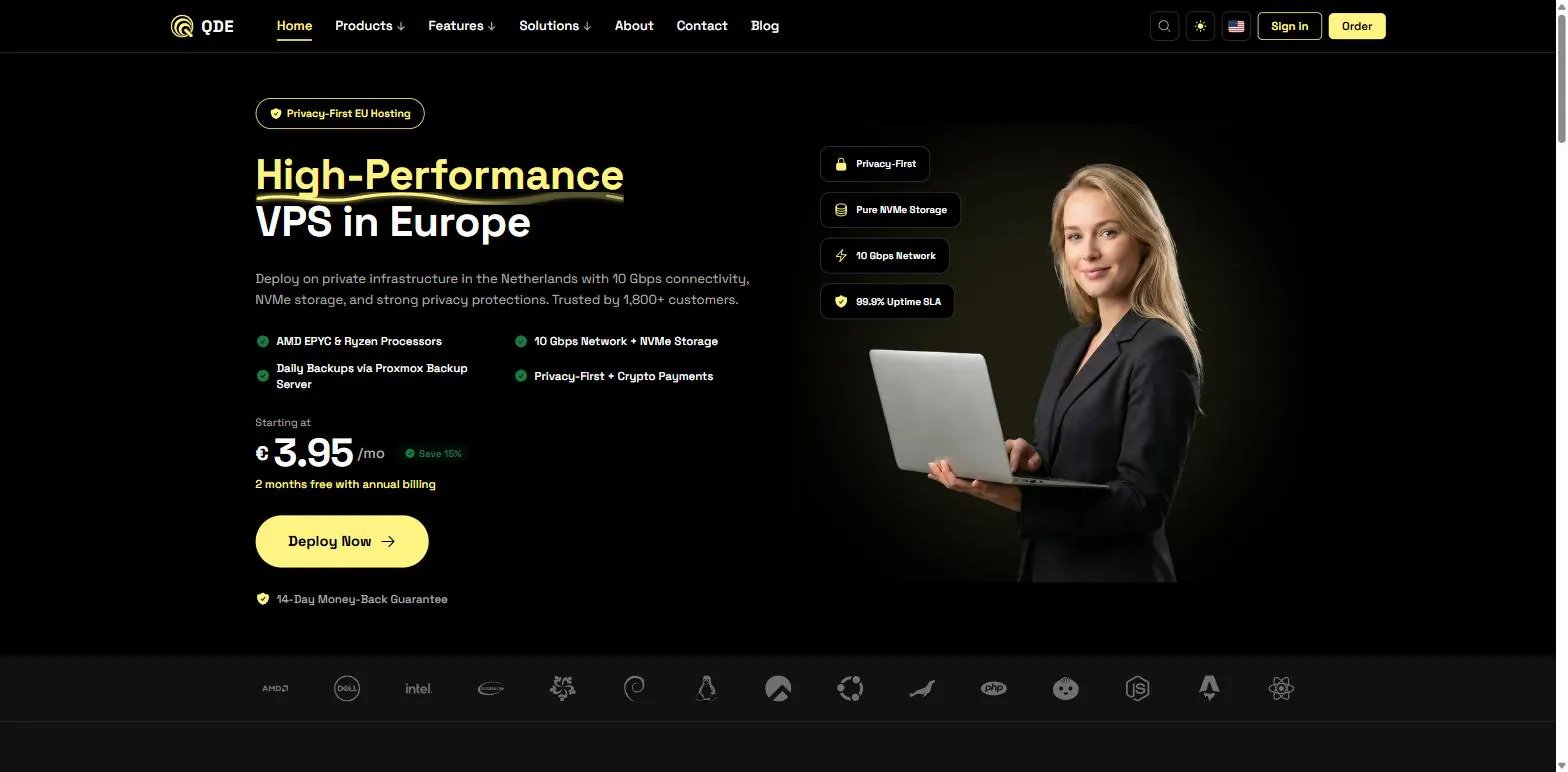
QDE is a Netherlands-based unmanaged VPS provider running out of a Tier III data center in Amsterdam with direct AMS-IX peering: dedicated (never oversold) RAM and NVMe storage, transparent flat pricing with no surprise renewal hikes, and root access without a bloated product catalog to wade through. It also supports crypto payments and leans into a privacy-first setup, which is worth knowing if either of those matters more to you than raw sticker price.
Note: Several of the providers below are competitors to QDE in the European VPS hosting market. We've made an intentional effort to represent all of them fairly.
2. Contabo
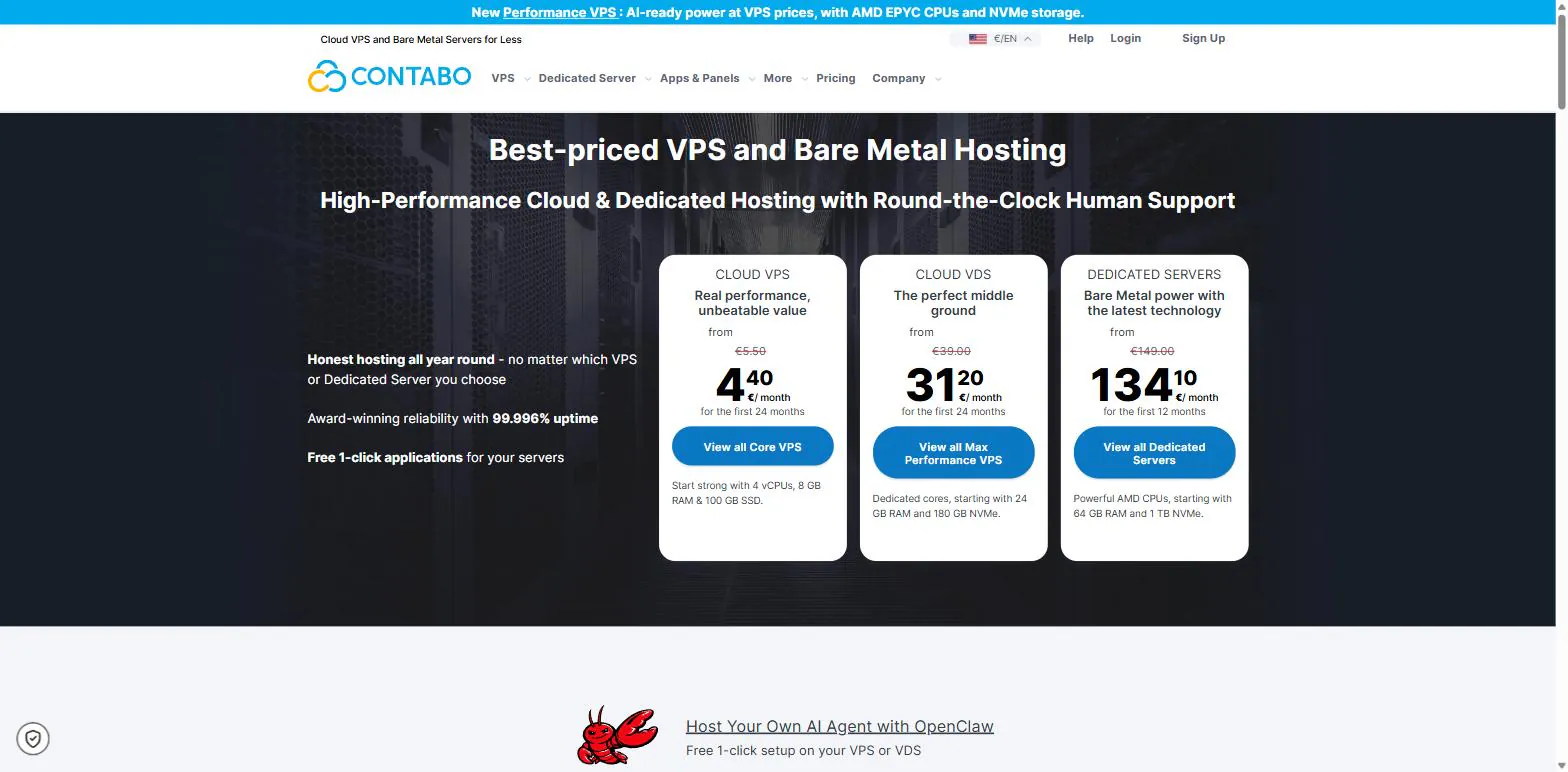
Contabo is one of the most aggressively priced options on this list, often undercutting competitors on raw specs per euro, with plans that look remarkably generous on paper. The trade-off shows up in shared network capacity and more variable performance during peak load, since Contabo's pricing generally means less headroom per server than pricier competitors, and its resource allocation model has historically leaned more toward oversubscription than some alternatives.
3. OVHcloud
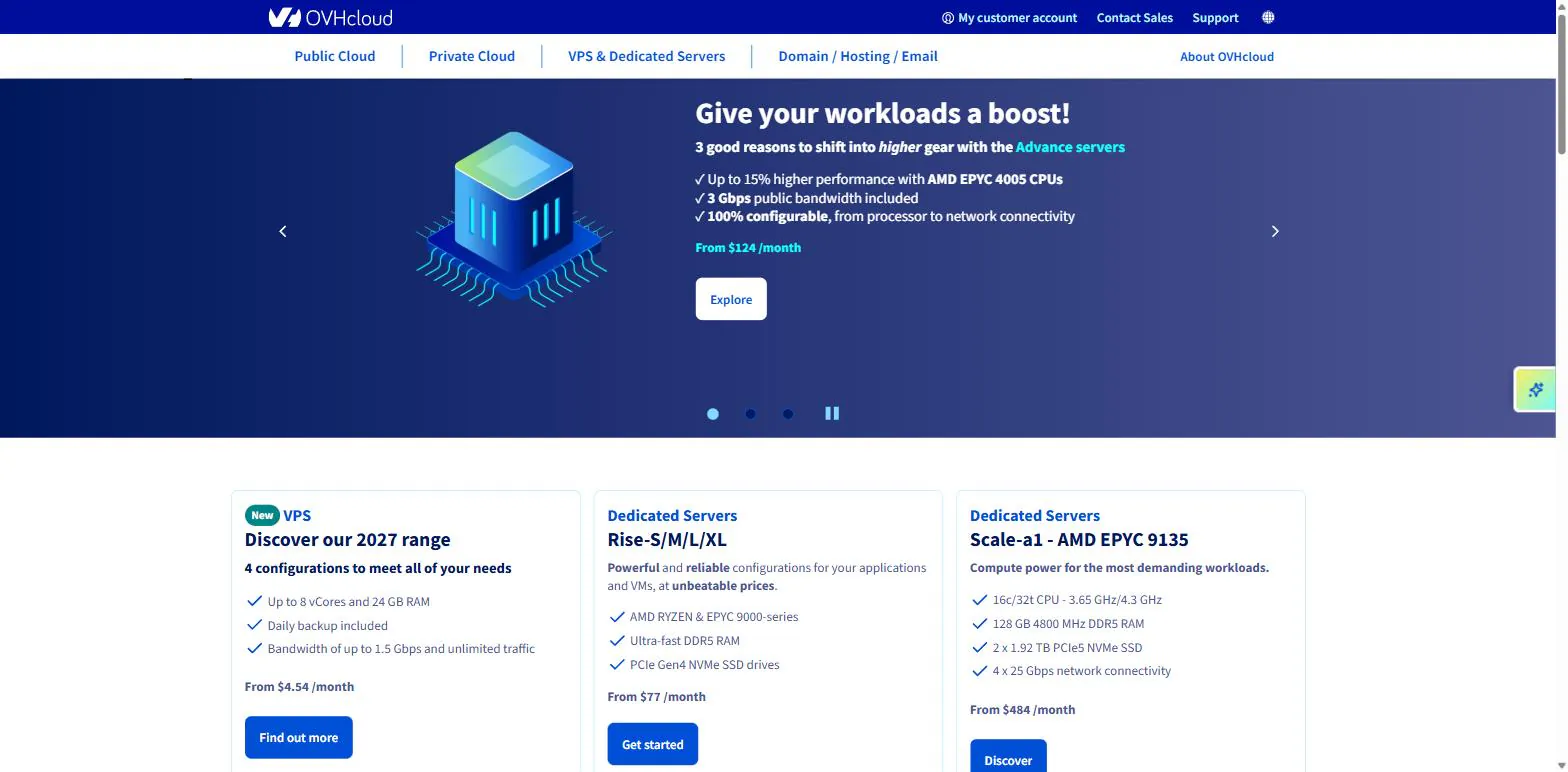
OVHcloud is a much larger, France-headquartered provider with data centers across Europe, North America, and Asia. It offers a broader range of products beyond VPS, including dedicated servers, cloud infrastructure, and managed Kubernetes, which makes it a reasonable choice if you expect to outgrow a simple VPS setup and want to stay with the same provider as your infrastructure needs grow.
The trade-off is a more complex product catalog and account structure that can feel overwhelming for a first-time VPS buyer compared to simpler, more narrowly focused providers.
4. Netcup
Netcup is a German provider known for solid price-to-performance ratios and a loyal, long-standing community. It tends to have less capacity strain during high-demand periods than some larger competitors, though its product range and English-language documentation aren't as extensive as some larger competitors, which can be a minor friction point for non-German-speaking customers.
5. IONOS
IONOS is one of the largest hosting companies in Europe, offering VPS alongside shared hosting, domains, and managed cloud products under one roof. It's a solid choice if you want a single provider for multiple services rather than piecing together infrastructure from several vendors, and its scale generally means strong uptime and support infrastructure. Its VPS pricing tends to run higher than budget-focused competitors, though.
6. Scaleway
Scaleway is a French cloud provider that leans more toward developer-focused cloud infrastructure than simple, budget VPS hosting. It offers more granular, cloud-native features (like managed Kubernetes clusters, object storage integration, and serverless functions) that go beyond what a straightforward VPS provider typically bundles in, making it a better fit for teams already thinking in cloud-native terms rather than a simple "one server" use case.
7. Hetzner
Hetzner has built a loyal following for a good reason: solid hardware, competitive pricing, and a straightforward product lineup that's made it a default recommendation in a lot of developer communities. Its data centers span Falkenstein, Nuremberg, and Helsinki, with additional locations in the US and Singapore, and its lineup covers both cloud VPS and dedicated hardware through its Robot platform.
Hetzner's growth has come with real trade-offs, though: longer support response times as the customer base has scaled, capacity shortages in popular locations during high-demand periods, and a KYC verification process that trips some customers up at signup.
Comparing renewal pricing, not just introductory pricing
One detail that's easy to miss when comparing providers on price alone: some VPS companies offer attractive first-term pricing that increases meaningfully on renewal, sometimes by a significant percentage. Before committing based on a headline price, check what the plan actually costs on its second and third billing cycle, not just the first. Providers that keep renewal pricing identical to the initial rate, rather than treating it as a promotional hook, tend to be more transparent overall about their business model.
How to actually decide
Specs on a pricing page only tell part of the story. Before committing, it's worth testing a provider's actual network performance from wherever your users are, using a public looking glass tool, and checking whether resources are truly dedicated or oversold by reading recent independent reviews.
It's also worth confirming exactly what happens to pricing after any introductory period ends, checking each provider's refund policy, and seeing how quickly support actually responds to a real ticket, ideally by testing this yourself with a pre-sales question before signing up.
Wrapping up
Each of these seven providers approaches European VPS hosting a little differently, and depending on what you value most, location, resource guarantees, payment flexibility, or support quality, one of them might fit your project better than the rest. The right choice comes down to matching a provider's specific trade-offs to what your project actually needs, not just picking whichever name comes up most often in a forum thread.
Thanks for reading! If Netherlands-based infrastructure with dedicated resources and direct AMS-IX peering fits what you're looking for, QDE provides high-performance, unmanaged VPS hosting backed by NVMe storage and 10 Gbps uplinks, with RAM and storage that are never oversold.
Frequently asked questions about European VPS hosting providers
Do all seven of these providers perform the same?
No. Even providers with similar reputations can differ meaningfully in network quality, resource guarantees, and support responsiveness, sometimes even between specific plan tiers within the same company. Test the specific plan you're considering rather than assuming a provider's general reputation applies uniformly.
What's the most common complaint across providers like these?
Across budget and mid-market VPS providers generally, the most common issues are capacity shortages in popular locations during high-demand periods, KYC identity verification steps some customers find intrusive, and support response times that can lag as a provider's customer base scales. None of it is unique to one name on this list, it's worth checking recent reviews for whichever provider you're considering.
Are cheaper providers always a worse deal?
Not necessarily worse, but usually different. Cheaper providers often mean less network headroom or more oversold resources, while pricier alternatives may offer more dedicated capacity or a broader product range.
How do I test a VPS provider's network before committing?
Most providers, including QDE, offer a public looking glass or speed test tool you can use to check latency and throughput from your own location before signing up.
Should I worry about renewal pricing when comparing providers?
Yes, it's worth checking directly. Some providers advertise attractive introductory pricing that increases substantially after the first term, so comparing only first-year prices can be misleading.
How long does it usually take to migrate from one VPS provider to another?
It varies by project complexity, but a straightforward website or small application can typically move in a few hours of hands-on work, plus DNS propagation time. Larger applications with databases and multiple services take longer and benefit from a staged migration plan.