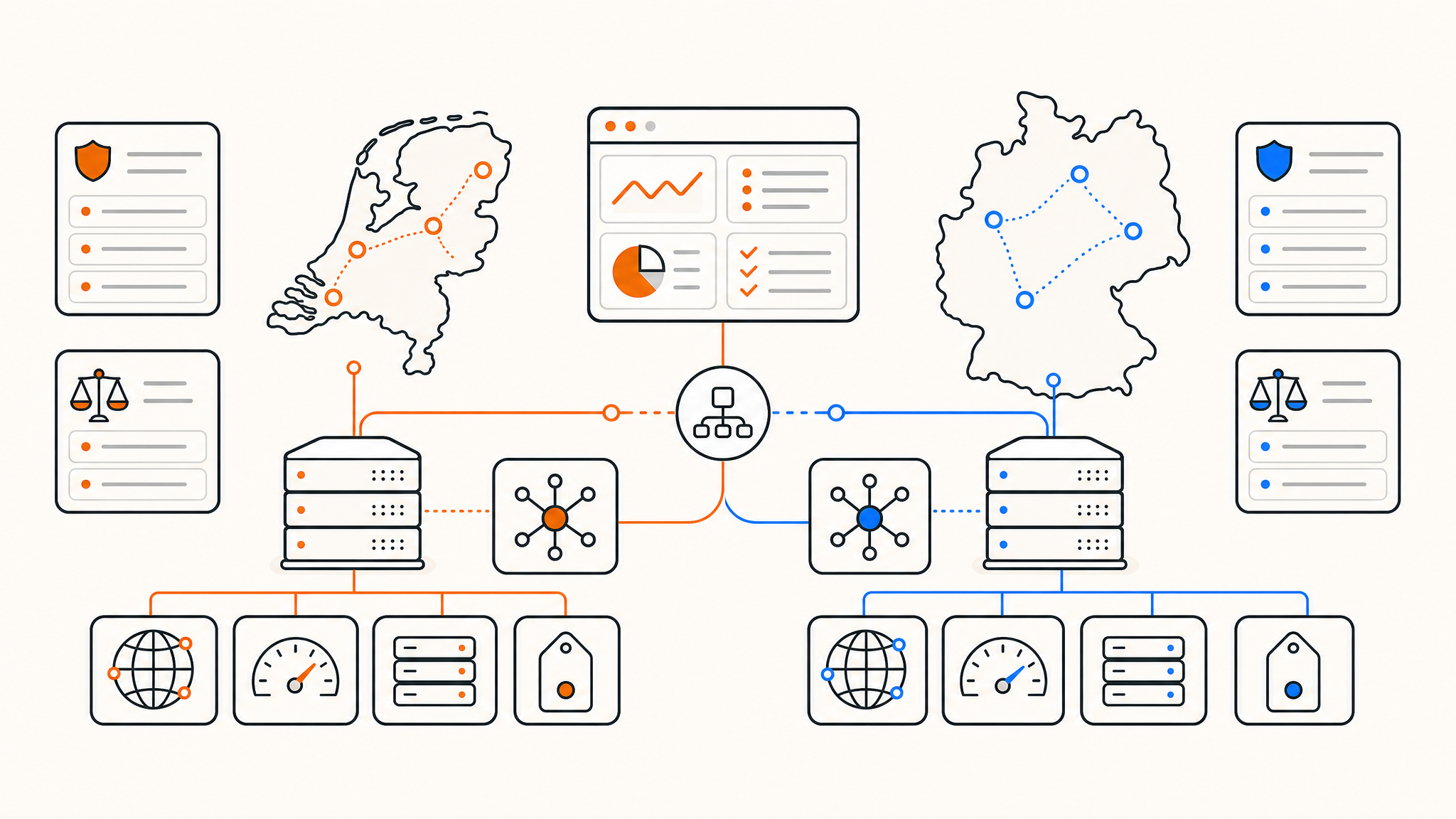
If you're shopping for European hosting, two countries keep coming up: the Netherlands and Germany. Both sit at the center of the continent's network map, both fall under GDPR, and both run on dense fiber and serious data center capacity. So when it comes to Netherlands vs. Germany hosting, the honest answer is that you can't really go wrong with either; the differences are in the details.
Those details matter more than people expect. Where your server physically lives affects latency to your users, which legal framework governs your data, how takedown requests get handled, and what you'll pay each month. This article walks through how Amsterdam and Frankfurt compare on the things that actually move the needle, then helps you decide which one fits your project.
Why these two countries dominate European hosting
Amsterdam and Frankfurt are both part of the "FLAP-D" group, the cluster of cities (Frankfurt, London, Amsterdam, Paris, Dublin) that anchors most of Europe's internet infrastructure. They have the most data centers, the most network operators, and the most interconnection capacity on the continent.
That concentration creates a feedback loop. More networks in one place means lower-latency peering, which attracts more networks, which pulls in more hosting providers and cloud regions. Both cities have been riding that loop for nearly three decades, and it's the main reason a VPS in Amsterdam or Frankfurt tends to outperform one in a less-connected location.
The practical upshot for you: whichever you pick, you're getting access to world-class connectivity. The real question is which flavor of "world-class" suits your audience and your workload.
Network connectivity and peering
This is where the two diverge in an interesting way, and it comes down to their flagship internet exchanges.
Germany's DE-CIX in Frankfurt is the largest internet exchange in the world by peak traffic. Its Frankfurt platform regularly pushes past 18 Tb/s at peak, with roughly 1,100 networks connected at that single metro. Frankfurt is also the gateway for traffic heading into Eastern Europe and a magnet for cloud on-ramps and financial networks, which is part of why DE-CIX named it the world's leading digital hub in 2025.
The Netherlands runs on AMS-IX in Amsterdam, one of the oldest and most respected exchanges anywhere. AMS-IX hit a traffic peak of 14.2 Tb/s in early 2025 and moved more than 35 exabytes of data across the year, with around 900 connected parties. Amsterdam leans heavily toward content delivery, streaming, and gaming traffic, and it sits at the European landing point for several transatlantic cables.
Both exchanges are carrier-neutral and deliver low-latency reach across Europe, North America, and Asia. If you want to dig deeper into how Amsterdam earned its place, we covered it in detail in what AMS-IX is and why it matters.
Latency and geographic reach
Geography is subtle here because both cities are central, but they tilt in different directions.
Frankfurt's strength is reach into the DACH region (Germany, Austria, Switzerland) and onward into Central and Eastern Europe. If most of your users are German-speaking or sit east of the Rhine, Frankfurt usually shaves a few milliseconds off the round trip. It's also the default choice for anything latency-sensitive that touches European financial markets.
Amsterdam tends to win for transatlantic traffic, the UK, the Nordics, and Western Europe generally. The transatlantic cable landings make it a strong base if you serve a mixed European and North American audience from a single location.
In real terms, the gap between them across most of Western and Central Europe is small, often a single-digit millisecond difference. Unless you're running something where every millisecond counts, your audience map matters more than the raw numbers. You can always test real-world latency to a Dutch location yourself using QDE's network looking glass.
Data privacy and legal jurisdiction
Here's where a lot of buyers make their decision, and where the nuance is easy to miss.
Both countries enforce the GDPR, so the baseline for data protection is the same high European standard. Each also has its own national layer on top: Germany has the Federal Data Protection Act backed by a federal authority and 16 separate state-level data protection agencies, while the Netherlands implements GDPR through its own act overseen by the Dutch Data Protection Authority.
Germany has a particularly strong privacy reputation, rooted in a constitutional right to "informational self-determination." German courts have historically pushed back hard on government data collection; the Federal Constitutional Court struck down the country's transposition of the EU data retention directive for being disproportionate. That history gives Germany real credibility with privacy-conscious users.
The Netherlands holds an equally solid GDPR posture with a pragmatic, business-friendly regulator. One detail worth knowing: both Germany and the Netherlands are members of the 14 Eyes intelligence-sharing alliance.
Content rules and takedown culture
This is the difference people feel most in day-to-day operations.
Germany runs a stricter content environment. Its Network Enforcement Act (NetzDG) imposes fast takedown obligations and fines reaching €50 million, though it targets large social platforms rather than hosting providers directly. More relevant to most site owners is Germany's aggressive copyright enforcement and its "Abmahnung" warning-letter culture, where rights holders send formal cease-and-desist notices that can carry real legal cost. Germany also enforces strict rules around certain categories of speech and imagery.
The Netherlands takes a more measured approach. It operates under a well-established notice-and-takedown code of conduct, and Dutch hosts generally have a reputation for being even-handed about handling complaints rather than reflexively pulling content. For projects that need predictable, proportionate handling of abuse reports, that culture is a meaningful advantage.
Neither approach is "better" in the abstract. If your content is mainstream and you value Germany's privacy pedigree, the stricter regime may not affect you at all. If you want a host that won't overreact to a single complaint, the Dutch model tends to be the gentler one.
Pricing and market dynamics
Germany has long been associated with budget-friendly hosting, thanks partly to large domestic providers competing on price and the sheer scale of capacity around Frankfurt. If raw cost-per-gigabyte is your only metric, German bargain tiers can be hard to beat.
The Netherlands competes on a slightly different axis. Dutch hosting is priced competitively, but the country has carved out a strong identity around privacy-focused, crypto-friendly, and unmetered or high-bandwidth offerings. Providers there are more likely to accept anonymous-leaning payment methods and to position around data sovereignty rather than rock-bottom pricing alone.
So the trade-off often looks like this: Germany for maximum capacity at low cost, the Netherlands for a balance of performance, privacy positioning, and flexible payment. For most serious projects, the monthly difference between comparable specs is small enough that connectivity and jurisdiction should outweigh a few euros.
How to choose between the Netherlands and Germany
A few quick decision rules cover most situations.
Pick Germany if your audience is concentrated in the DACH region or Eastern Europe, you want the deepest interconnection at DE-CIX, or you're optimizing purely for the lowest possible cost on large capacity. It's also a natural fit if Germany's constitutional privacy reputation is a selling point for your users.
Pick the Netherlands if you serve a mixed European and transatlantic audience, you run content-heavy, streaming, or gaming workloads that benefit from Amsterdam's peering profile, or you want flexible and privacy-respecting payment options. The lighter-touch content culture is a bonus for anyone who wants predictable handling of complaints.
When the two are close, default to the Netherlands for general-purpose hosting and Germany only when its specific strengths (cost at scale, DACH latency, DE-CIX depth) clearly apply to you. And remember you can always run a short test on a monthly plan before committing, since neither choice locks you in.
Conclusion
The Netherlands and Germany are both excellent places to host, and the right pick depends on your audience, your workload, and how much weight you put on content culture versus raw cost. Germany leans toward unmatched interconnection and budget capacity; the Netherlands leans toward balanced performance, transatlantic reach, and a more flexible, privacy-minded environment.
If the Dutch side of that comparison fits your project, QDE runs unmanaged KVM VPS hosting from a Tier III data center in Amsterdam, with pure NVMe storage, 10 Gbps uplinks, direct AMS-IX peering, and crypto payment options for anyone who values privacy. RAM and storage are never oversold, so you get exactly what your VPS plan lists.
Not sure which location or spec fits best? Contact our team and we'll help you find the right setup for your project.
Frequently asked questions about Netherlands vs. Germany hosting
Is the Netherlands or Germany better for privacy?
Both enforce GDPR and have strong national data protection laws, so the baseline is equally high. Germany carries a stronger privacy reputation thanks to its constitutional protections, while the Netherlands pairs solid GDPR compliance with a pragmatic regulator and flexible, privacy-friendly payment options. Note that both countries belong to the 14 Eyes alliance.
Which has better network connectivity?
Germany's DE-CIX in Frankfurt is the world's largest internet exchange by peak traffic and the strongest gateway into Eastern Europe. The Netherlands' AMS-IX in Amsterdam is one of the largest globally and excels for transatlantic, streaming, and content delivery traffic. Both offer low-latency reach across Europe.
Is German hosting cheaper than Dutch hosting?
German hosting is often associated with lower budget pricing due to large domestic providers and heavy capacity around Frankfurt. Dutch hosting is competitively priced but tends to emphasize performance, privacy, and flexible payment rather than the absolute lowest cost.
Does Germany censor hosted content more than the Netherlands?
Germany has a stricter content environment, including fast takedown rules for large platforms and aggressive copyright enforcement. The Netherlands uses a notice-and-takedown code of conduct and is generally known for proportionate, even-handed handling of complaints.
Which should I choose for a European and US audience?
The Netherlands is usually the better default for a mixed European and transatlantic audience because of Amsterdam's transatlantic cable connections and content-friendly peering. Choose Germany if your users are concentrated in the DACH region or Eastern Europe.
Can I test latency before committing?
Yes. You can check real-world latency to a Dutch location using QDE's network looking glass, and since QDE bills monthly with no long-term contract, you can run a short trial before deciding.