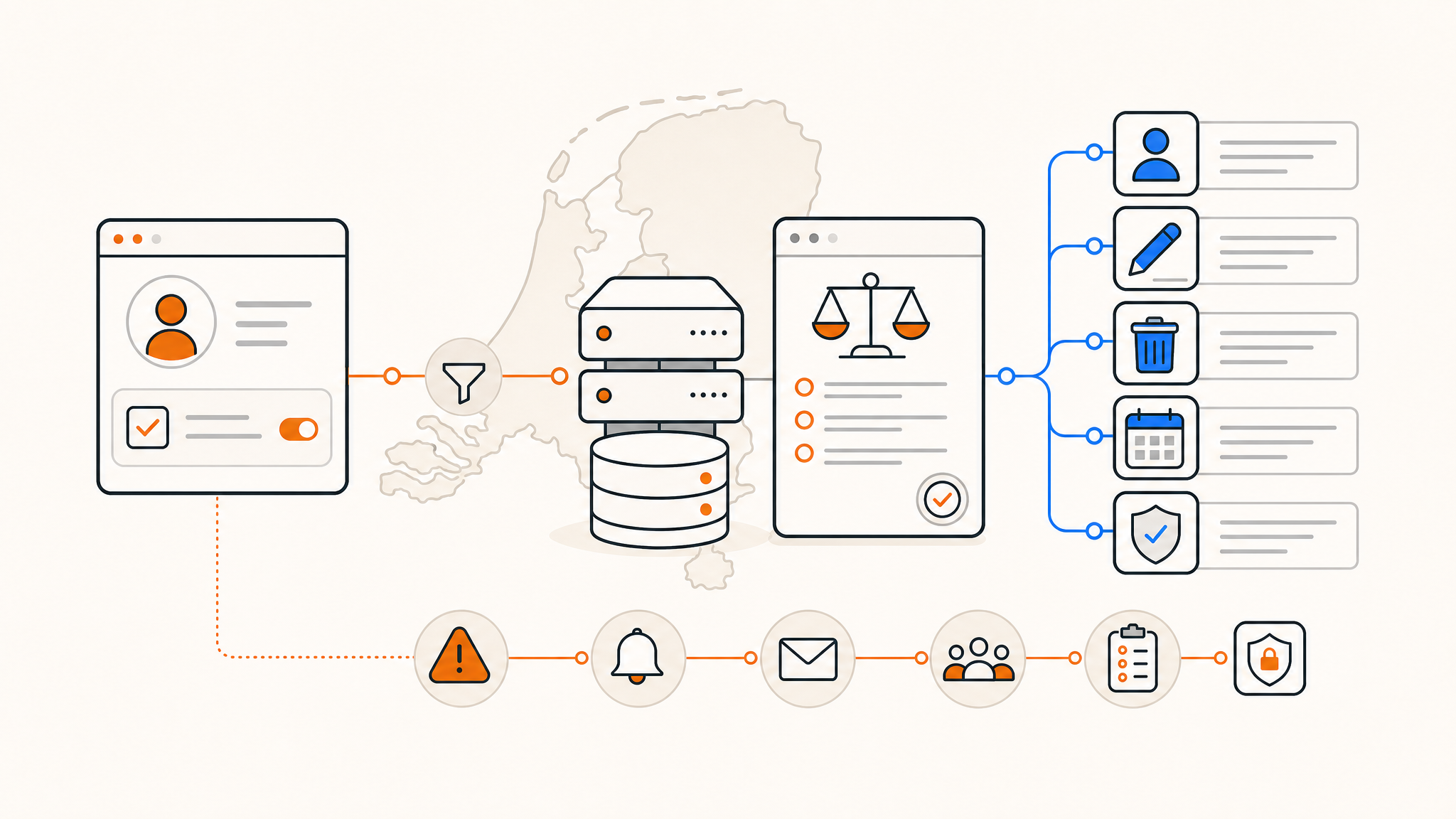
If you're hosting a website, application, or service on servers in the Netherlands, data privacy law isn't just a background concern — it's something that affects how you collect data, who you can share it with, and what happens if something goes wrong. The Dutch legal framework is thorough, and while it's rooted in EU-wide regulation, there are local layers worth understanding before you deploy.
This article walks through the key laws that apply, what they mean in practice for hosting customers, and how to think about your obligations whether you're running a SaaS product, a community forum, an internal business tool, or beyond.
The GDPR: the foundation everything builds on
The General Data Protection Regulation (GDPR) — known in the Netherlands as the AVG, short for Algemene Verordening Gegevensbescherming — is the baseline. It's an EU regulation, which means it applies directly in all member states without needing to be translated into local law. If you process personal data of EU residents, it applies to you, regardless of where your business is registered.
The GDPR rests on a handful of core principles: you need a lawful basis to process personal data, you should only collect what's necessary, you must store it securely, and you can't keep it indefinitely. It also grants individuals a set of rights — access, correction, deletion, portability — that you're obligated to support.
For hosting customers, the most relevant piece is the controller-processor relationship. If your hosting provider touches personal data on your behalf (which is common), you need a Data Processing Agreement (DPA) in place. This agreement must set out the subject matter and duration of the processing, the nature and purpose of the processing, the type of personal data involved, and the obligations and rights of the controller.
The UAVG: where Dutch law adds its own layer
The Dutch GDPR Implementation Act (Uitvoeringswet AVG, or UAVG) constitutes the local implementation of the GDPR in the Netherlands. It follows a policy-neutral approach, meaning the requirements of the previous Dutch Data Protection Act are maintained insofar as possible under the GDPR.
In practical terms, the UAVG fills in the gaps where the GDPR intentionally leaves room for member states to legislate. Among other things, the UAVG sets the age of digital consent at 16, refines GDPR provisions governing employment relationships, and adds further safeguards for processing special categories of personal data.
If your application processes data from Dutch users — especially minors — that age-of-consent rule matters. You can't rely on parental consent workarounds that might be acceptable in other jurisdictions.
The Autoriteit Persoonsgegevens: who enforces it
The Dutch Data Protection Authority (Autoriteit Persoonsgegevens, or AP) is the national regulatory authority on all things data protection. It handles enforcement, investigates complaints, and has the power to issue fines.
Those fines follow the GDPR's two-tier structure. Violations of organizational obligations — such as failing to appoint a Data Protection Officer, failing to maintain records of processing activities, or failing to conduct a Data Protection Impact Assessment — can result in fines up to EUR 10 million or 2% of global annual turnover. Violations of core data protection principles, such as processing data without a legal basis or violating data subject rights, can go up to EUR 20 million or 4% of global annual turnover.
The AP doesn't just sit idle. For 2024 and 2025, the AP identified four strategic enforcement priorities, including algorithms and artificial intelligence, addressing automated decision-making risks. That's worth noting if your application uses any form of profiling or automated decisions that affect users.
What counts as personal data
This is where a lot of hosting customers trip up. Personal data isn't just names and email addresses. It includes customer and personnel numbers, internet purchasing behaviour, trade union membership, religion, medical information, and video and sound recordings on which a person can be recognised.
IP addresses stored in server logs are also generally considered personal data under GDPR, which means your standard web server access logs could put you in scope if you're not careful about retention periods and access controls.
Lawful bases for processing
You cannot just process personal data — you must have at least one of six recognized reasons: it is necessary to carry out an agreement, it is necessary to fulfill a legal obligation, there is a legitimate interest, you have permission from the person in question, it is necessary to protect someone's life or health, or it is necessary to perform a task in the public interest.
For most commercial applications, the relevant bases are contract (processing data to deliver a service the user signed up for) and consent (for anything beyond that, like marketing). Legitimate interest can apply in some cases, but it requires a balancing test and can't be used as a catch-all.
Data breach notification rules
If something goes wrong — a breach, unauthorized access, accidental exposure — you have limited time to act. Under the GDPR, you must notify the AP within 72 hours of becoming aware of a breach that poses a risk to individuals. Depending on the severity, you may also need to notify the affected users directly.
This is one area where your hosting setup matters. If you're on an unmanaged VPS, you control the stack, which means breach response is your responsibility. Having monitoring in place, maintaining access logs, and knowing who can reach your data are all part of being prepared.
Transferring data outside the Netherlands
Transferring personal data outside the European Economic Area requires adequate safeguards under Chapter V of the GDPR. Data may flow freely to countries the European Commission has recognized as providing adequate protection, including Japan, the United Kingdom, and the United States under the EU-US Data Privacy Framework.
For any country without an adequacy decision, you'll typically need Standard Contractual Clauses (SCCs). If your application uses third-party services — analytics, CDN providers, email delivery — check whether those vendors process EU personal data and what transfer mechanisms they rely on. Many hosting customers overlook this when integrating external APIs.
What this means for your hosting setup
Choosing to host in the Netherlands carries a few practical advantages from a compliance standpoint. Your data stays in the EU, you're subject to well-defined GDPR enforcement, and there's no ambiguity about jurisdiction for most use cases. You don't need to worry about cross-border transfers for EU users as long as processing stays within the EEA.
That said, the server location doesn't do the compliance work for you. You still need to:
- Have a privacy policy that clearly states what you collect and why
- Implement a Data Processing Agreement with any processor handling personal data on your behalf
- Only collect data that's actually necessary for your service
- Have a process for handling data subject requests (access, deletion, correction)
- Maintain records of your processing activities if you're not a small business operating below GDPR thresholds
You should not keep personal data for longer than necessary. Only a very limited number of people in your company should have access to this data, and you may have to carry out a Data Protection Impact Assessment (DPIA) to assess the risks of data processing.
A note on the Dutch Telecommunications Act
Chapter 11 of the Dutch Telecommunications Act implements the requirements of the ePrivacy Directive, which provides a specific set of privacy rules for the processing of personal data in electronic communications. This is primarily relevant if you're operating a communications platform or if your site uses tracking technologies like cookies.
In November 2025, the Dutch Data Protection Authority updated Dutch cookie banner guidelines. Opt-in consent is required for non-essential cookies such as tracking or marketing cookies. Prior consent is mandatory. If your application or website runs any non-essential analytics or advertising, you need a properly structured consent mechanism — a banner that pre-checks consent boxes or makes refusal harder than acceptance won't cut it.
Conclusion
Hosting in the Netherlands means operating under one of the more clearly defined privacy frameworks in the world. GDPR provides the foundation, the UAVG adds Dutch-specific requirements, and the AP enforces both with real consequence. Understanding where your obligations lie — particularly around lawful bases, data processing agreements, breach notification, and cross-border transfers — is what keeps you on the right side of it.
Whether you're building a customer-facing product or running internal infrastructure, the fundamentals apply: collect less, document more, secure everything, and know how to respond when something goes wrong.
Thanks for reading! If you're looking for a compliant, privacy-conscious hosting base in the Netherlands, QDE provides high-performance VPS hosting in Amsterdam, backed by NVMe storage, 10 Gbps uplinks, and a GDPR-compliant infrastructure with minimal data collection and no third-party data sharing.
Ready to get started or have questions about your setup? Contact our team — we're happy to help you find the right plan for your project.
Frequently asked questions about Netherlands data privacy laws and hosting
Does Netherlands hosting automatically make me GDPR compliant?
No. Hosting your data in the Netherlands means it stays within the EU and avoids cross-border transfer issues for most use cases, but compliance is determined by how you collect, process, and manage personal data — not where the server sits. You still need lawful bases, processing agreements, a privacy policy, and breach response procedures in place.
What is the UAVG and how is it different from GDPR?
The UAVG (Uitvoeringswet AVG) is the Dutch law that implements and supplements the GDPR locally. The GDPR applies directly across all EU member states, but it leaves certain areas open to national legislation. The UAVG fills those gaps, including setting digital consent age at 16 and adding extra rules for special categories of data and employment contexts.
Who enforces data privacy law in the Netherlands?
The Autoriteit Persoonsgegevens (AP) is the Dutch Data Protection Authority. It handles enforcement of both the GDPR and the UAVG, investigates complaints, and can issue fines up to EUR 20 million or 4% of global annual turnover for serious violations.
Do I need a Data Processing Agreement with my VPS provider?
If your VPS provider processes personal data on your behalf — even incidentally, such as through log access or backup systems — yes, a DPA is required under GDPR Article 28. Check your provider's terms or ask them directly whether they offer a DPA. QDE can provide this.
What is a Data Protection Impact Assessment (DPIA) and when do I need one?
A DPIA is a formal risk assessment for processing activities that are likely to result in high risk to individuals — such as large-scale profiling, processing special categories of data, or systematic monitoring. If your application does any of these things, a DPIA may be mandatory before you go live.